
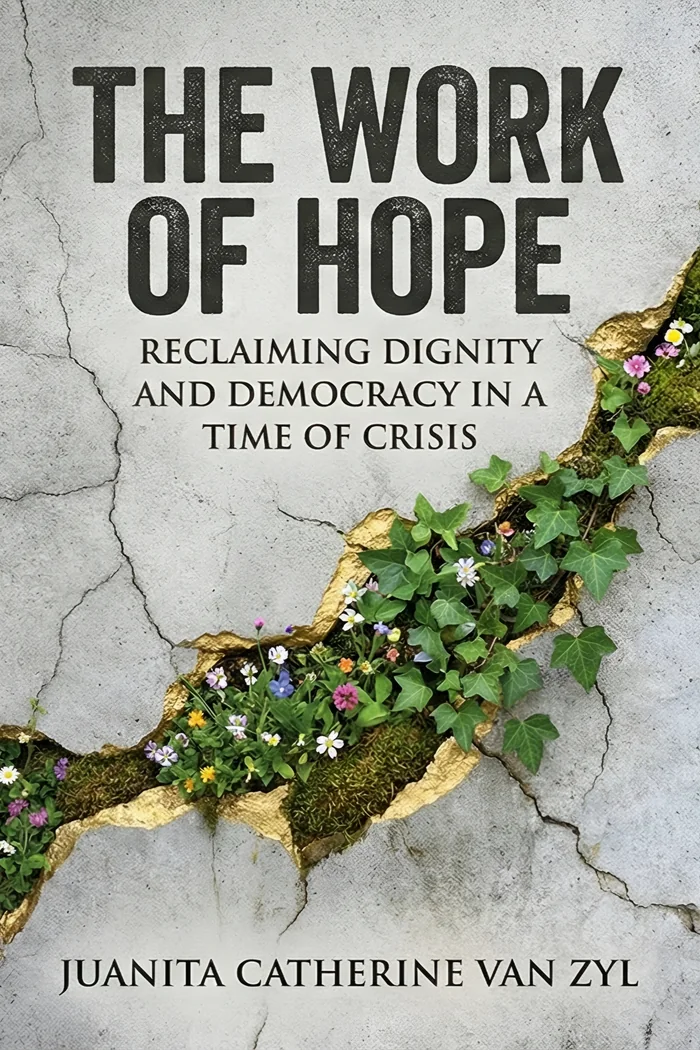
The Work of Hope
Reclaiming Dignity and Democracy in a Time of Crisis
Democracy is not dying in one dramatic explosion. It is being hollowed out quietly: by budget lines and bathroom bills, by insurance codes and missing stamps, while we are told to stay positive and wait our turn.
Juanita Catherine van Zyl has lived on both sides of that hollowing. She grew up inside the machinery of Apartheid South Africa, the child of a prison officer, and watched a miracle democracy leave its economic promises unkept. Then she emigrated to the United States, where, as a transgender woman, an immigrant, and a cancer survivor, she learned a harder lesson: in South Africa the system fails because it is broken; in America it fails because it is working exactly as designed.
The Work of Hope is part diagnosis, part toolkit. It names the machinery behind our age of crisis, from manufactured scapegoats to the quiet coup of paperwork. It introduces the People’s Democracy Index, a new way to measure a country by what it actually delivers: housing, healthcare, safety, dignity. Five nations are scored in full and the workings are printed, so that every number can be argued with. And it closes each of its twenty-two chapters with a practice you can do this week, because hope is not optimism.
Hope is a discipline. This book teaches you how to work it.
Contents
Before You Begin
Part I. Where We Are: The Honest Diagnosis
- Chapter 1The Polycrisis Is Not a Mood9 minThe strong sense of instability we feel today is not just in our heads. Imagine waking up to a world where a freak storm floods a warehouse crucial to food distribution. At the same time, a bank…
- Chapter 2Democracy, as Marketed vs. Democracy, as Lived12 minWe are raised on a specific “brand story” of democracy. It is a narrative of inevitable progress, in which casting a ballot is the supreme act of freedom, and institutions exist to protect the…
- Chapter 3Inequality as a System Feature8 minWe are often told that poverty is a symptom of laziness and wealth is a symptom of virtue. This is the “Gospel of Innocence” applied to economics: a narrative that suggests the market is a neutral…
- Chapter 4The Identity Wars: Manufactured Conflict, Real Harm7 minYet in both South Africa and the United States, I have seen how quickly a human life can be reduced to a political symbol. The “Identity Wars” are not essentially about the identities being targeted,…
- Chapter 5Climate Breakdown Is a Democracy Issue5 minThe summer sun beats down relentlessly on a cracked, blistering block, once marked by the infamous red lines of history. A heat shimmer blurs the edges of this neighborhood, where shadow is a rare…
- Interlude APersonal Lens: Learning to See the System3 minI learned about the Architecture of Control long before I had the language to name it.
Part II. What’s Breaking: How Democracies Collapse (Quietly, Then All at Once)
- Chapter 6The Slow Coup: How Authoritarianism Arrives in a Suit8 minThe most authoritarian sentence ever spoken to me was: “I’m sorry, Sir. We can’t help you. These documents don’t have the practice stamps.”
- Chapter 7Information Breakdown5 minWe often speak of “fake news” as a glitch in the system, a problem of bad actors or poor moderation. But to understand the information breakdown, we must recognize that the chaos is not a bug; it is…
- Chapter 8The Hollowing of Rights8 minWe are often taught that rights are a single, fixed list, usually the civil and political protections in the US Bill of Rights, such as speech, assembly, and religion. However, as my experiences…
- Chapter 9Institutions That Don’t Serve People8 minWe are taught that institutions (the police, the medical system, the tax authority) are neutral arbiters designed to serve the public good. We believe that if we follow the rules, hold the proper…
- Chapter 10The Borderless Backlash4 minWe often view our local political crises as isolated events, such as a contentious election in one country or civil unrest in another. However, the polycrisis is not merely a collection of…
- Interlude BPersonal Lens: The Body as a Citizenship Test5 minI possess a Green Card. It is a thick, holographic, heavy plastic rectangle, designed to prove to the United States government that I am allowed to exist within its borders. It is supposed to be a…
Part III. Measuring What Matters: The People’s Democracy Index
- Chapter 11Why We Need a New Measure5 minWe are navigating a “fractured world” using maps drawn by the people who broke it.
- Chapter 12The Framework, and How to Use It Honestly10 minChapter 11 made the claim. This chapter builds the instrument that tests it, and the first thing any instrument needs is a definition of what it is measuring.
- Chapter 13The United States Through the PDI Lens8 minIf you look at the United States through traditional economic metrics, it appears robust. GDP is high, the stock market is active, and military hegemony is intact. Those numbers are a mask. They…
- Chapter 14South Africa Through the PDI Lens9 minIn 1994, the world watched a “miracle.” The transition from the Apartheid regime to a multiracial democracy was a triumph of the human spirit, answering the political question of liberation: we…
- Chapter 15Case Studies Across the Spectrum9 minDemocracy is not a switch that is either on or off. It is a spectrum of survival, and the useful question about any country is not whether it holds elections but how far down the income scale its…
- Interlude CA Brief Guide to Talking About Democracy Without Lying1 minThe Dictionary of the Thirdspace. If we want to build a new world, we must stop using the language of the old one. The Brand Story of democracy relies on euphemisms to hide violence. Here is a guide…
Part IV. What’s Possible: The Work of Hope
- Chapter 16Hope as Discipline6 minWe have spent the first three parts of this book staring into the abyss. We have diagnosed the Polycrisis, mapped the Slow Coup, and audited the Implementation Gap. If you are reading this and…
- Chapter 17Solidarity Is a Skill6 minWe are often told that solidarity is a feeling: a warm, spontaneous sense of connection with those who suffer. We assume that if we share an identity or an enemy, we will naturally know how to…
- Chapter 18Building Dignity-Based Systems4 minIn the brand story of democracy, dignity is often treated as an abstract sentiment or a private feeling. In the framework of the People’s Democracy Index (PDI) and The Work of Hope, dignity is not an…
- Chapter 19Repairing the Information Commons5 minWe often speak of the “digital divide” as a problem of access: who has the internet and who does not. But as we explored in the Polycrisis, the greater danger is the “Information Enclosure.”
- Chapter 20Democracy Under Pressure: Safety, Sanctuary, and Survival7 minIn the previous chapters, we used the PDI to diagnose the Implementation Gap: the dangerous chasm between the rights promised on paper and the reality of the street. We identified that for many (the…
- Chapter 21The Politics of Care7 minWe are conditioned to view “care” as a private sentiment: a soft, domestic obligation reserved for mothers, wives, and volunteers. In the brand story of democracy, care is what happens after the real…
- Chapter 22The Future We Choose5 minRichmond, California sits in the shadow of one of the largest oil refineries in the state. The people who live in its fenceline neighbourhoods breathe what it emits, and some of them have spent years…
Epilogue
Appendices
Copyright © 2026 Juanita Catherine van Zyl. All rights reserved.
Some names and identifying details have been changed to protect the privacy of individuals.
For the author’s personal safety, details of where she lives in Massachusetts have been changed or deliberately left vague. These are dangerous times for trans women, for immigrants, and for anyone who speaks plainly about power.